
A More Accurate Blood Test
Some of the most promising new research in Canada is being done by Dr. Christopher Mueller, a scientist at Queen’s University, and Sydney Shepherd, a PhD student working in his lab. Together, they’re studying mDETECT, the simple blood test that looks for DNA changes to help find and track ovarian cancer.
Mueller and Sheperd have focused their research on a recent breakthrough in oncology. Specifically, the liquid biopsies being developed by mDETECT a genomics company based in Kingston Ontario. The company is known for the development of highly sensitive blood tests that detect six of the most common cancers (breast, prostate, lung, ovarian, pancreatic and colorectal).
The standard blood test currently used to screen for ovarian cancer is known as CA-125. However, the effectiveness of the CA-125 test has long been questioned, as there is a significant need for a more reliable and precise method of detection. First, while elevated CA-125 levels can indicate the presence of ovarian cancer, this marker is not specific to the disease. There are numerous other conditions that can cause a rise in CA-125, many of which are not cancer-related. Moreover, some people with ovarian cancer, including myself, may not have elevated CA-125 levels.
DNA methylation patterns give a clearer and more reliable sign of cancer, “Our test specifically is looking at DNA methylation looking for almost these little flags on the DNA that are telling us that there’s a cancer signal or not,” explains Sheperd. “What we’ve seen is that our test is a lot more accurate than CA-125.”
Also encouraging is that Mueller confirms that mDETECT will be useful for monitoring patients post-treatment and detecting recurrence. “I can say from our lung cancer tests that we can see things six months or more in advance of CT scans. It’s the same technology that we apply to early detection for other cancers, with the caveat that we’re still probably a couple of years away from offering it to the public.”
So even though it’s still being tested, the technology could soon help find ovarian cancer coming back early, like it currently does in lung and breast cancer. “Success for this project means validating our tests in our real-world population,” articulates Mueller. “In this case, it’s all about identifying whether the patients that we’re looking at really do have ovarian cancer or not and can we differentiate them from patients who have other symptoms.”
A More Detailed Ultrasound
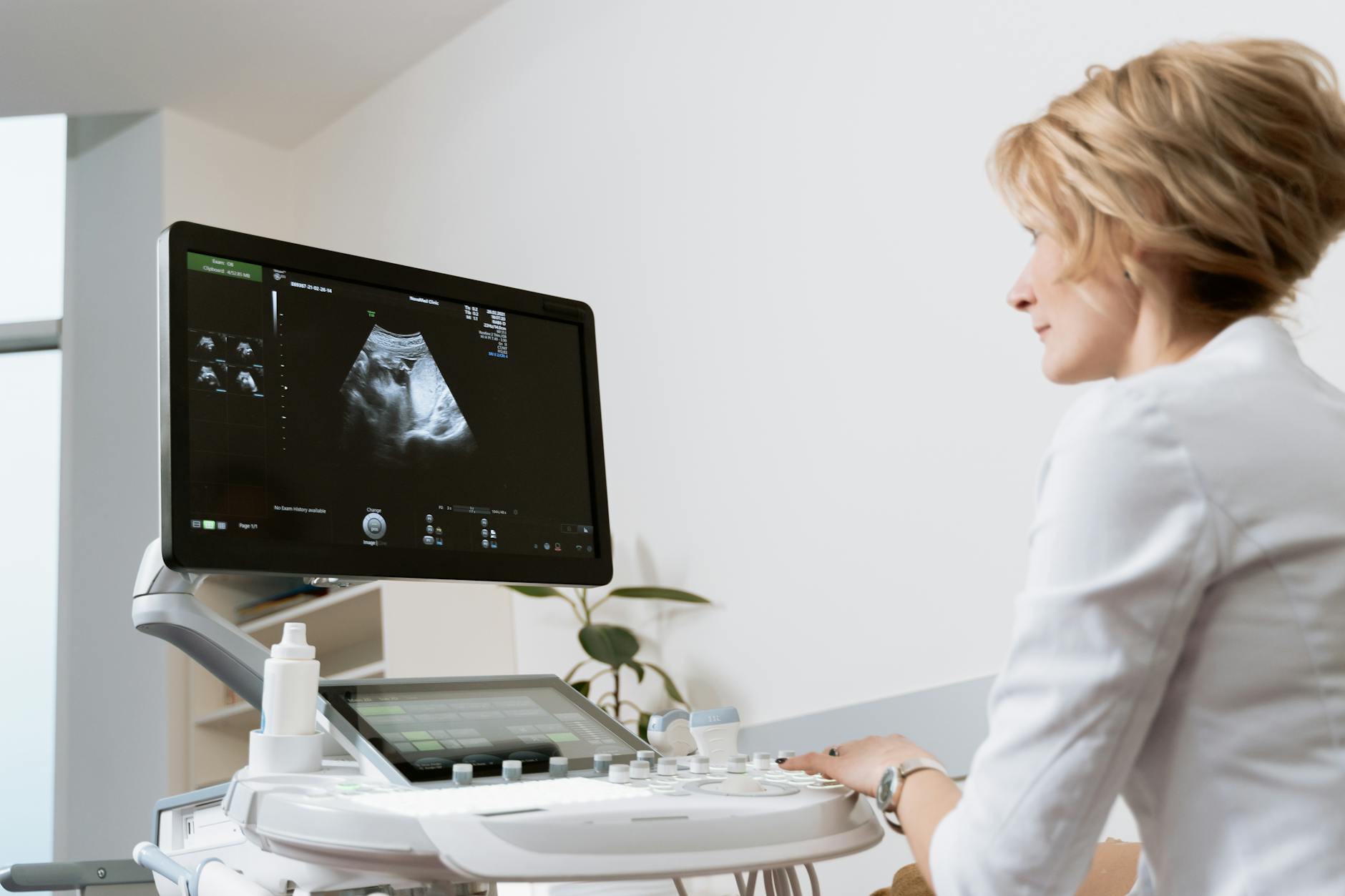
Meanwhile, there’s another study underway in my home city of Calgary, Alberta that may prove beneficial for more accurately diagnosing ovarian cancer. Traditional grey-scale ultrasounds have limitations to how much detail they can provide; it’s why patients are often sent for further tests like MRI or CT scans. But contrast enhanced ultrasound (CEUS), a relatively new imaging technique, uses minuscule bubbles and a contrast agent that is injected into a patient’s bloodstream to interact with the ultrasound waves to then produce more detailed images. The contrast agent improves the clarity, reliability and functionality of traditional ultrasound scans.
To date, CEUS has led to improved cancer diagnosis and has been widely approved for liver and kidney imaging but not yet for other organs, like ovaries. Although it shows a lot of promise for earlier malignant detection, fewer follow-up appointments and overall better care for women with pelvic masses, CEUS for ovarian lesions has not yet been fully evaluated.
Dr. Stephanie Wilson and her team at the Foothills Medical Centre are filling this need. Wilson is leading a pilot project to showcase the benefits of CEUS for ovarian lesions and is hopeful gynecologic oncologists will recognize the impact and use the technique more readily. “We want to look at the new application of these proven benefits of CEUS and apply them to the ovary,” she says.
Wilson’s department performed 25,000 CEUS scans between 2010 and 2022, and in the last year, she’s been using CEUS for patients with ovarian pathology. She explains that it’s a way to know whether a pelvic mass is benign. A benign ovarian mass is avascular, meaning there’s no blood flow. As a result, when a lesion is benign, the microbubbles used in CEUS cannot enter the mass. However, if a lesion is potentially malignant, the microbubbles will appear in the CEUS imaging and light up the lesion
“If we can confirm that something is benign, then we can reduce the amount of unnecessary follow-ups,” explains Wilson. “Although we cannot always tell with absolute confidence [if a mass is malignant], CEUS improves detection and characterization of malignant features. And the goal, of course, is expedited care.”














 The Teal Diaries: An Ovarian Cancer Journey